Rolls-Royce spent three years fixing engines that kept coming off wings. Having largely done it, the company is asking the British government to help it back into the part of the aviation market it walked away from.
The aerospace group is seeking UK government support for a re-entry into the narrowbody jet engine market, the Guardian reported ahead of this week's Farnborough airshow. Underlying profits for 2025 rose 40 percent to £3.5bn, and the share price is above £13, roughly ten times its level three years ago.
The market it is missing
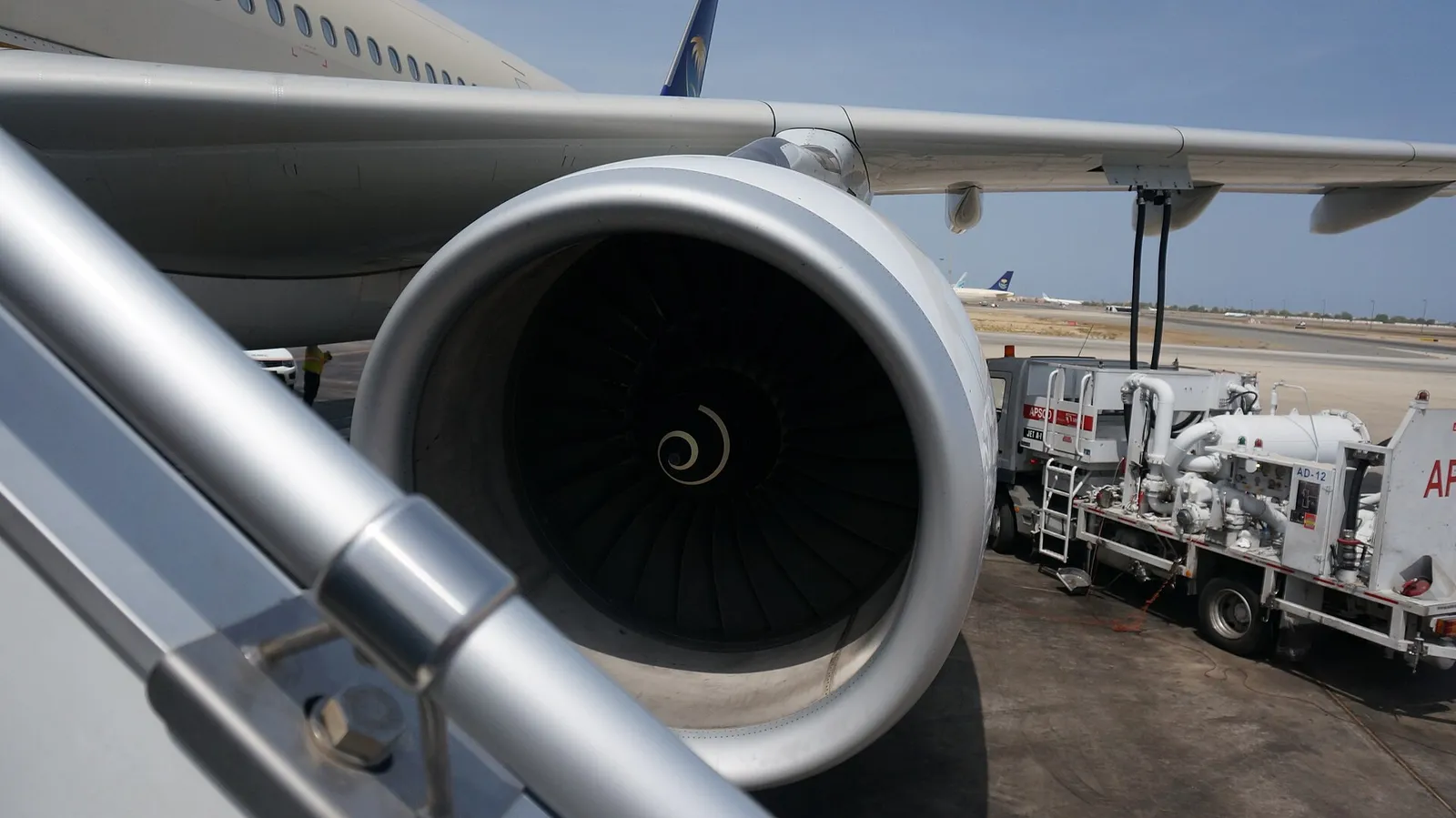
The strategic problem is easy to state. Rolls-Royce's Trent engines power widebodies, the twin-aisle long-haul aircraft: the Airbus A330, A350 and A380, and Boeing's 787 and 777. That is a prestigious business and a comparatively small one.
Narrowbodies, the single-aisle aircraft that fly most short-haul routes, are built and sold in far greater numbers. Rolls-Royce is not in that market, which means the largest segment of commercial aviation is closed to it. A company can be excellent in widebodies and still be capped by arithmetic.
Re-entry is not a decision that can be executed quickly. A new engine programme costs billions and takes many years, and it only works if an airframer selects it, which in turn depends on when Airbus and Boeing choose to launch their next single-aisle aircraft. That timing is not in Rolls-Royce's control, which is part of why government involvement is being sought.
What went wrong, and what fixing it involved
The Trent problems were serious enough that chief executive Tufan Erginbilgiç described the company as a "burning platform" when he arrived in 2023. Durability issues, including cracking in turbine blades, sent engines back to the workshop far too often, grounded aircraft, and led to disputes with airline customers.
The engineering explains why this is hard. Each Trent engine has 68 turbine blades, each around 10cm long, and each enduring the force of a double-decker bus on its end while generating the power of a Formula One car. They operate at close to 1,700C, well above the melting point of steel, hot enough to turn airborne sand into glass. To survive that, each blade is grown from a single crystal of nickel and aluminium superalloy, which gets stronger as temperature rises.
The fix was subtle rather than dramatic: changing the pattern of tiny cooling holes to raise airflow and improve blade cooling by 40 percent, and trimming weight from the top of the blade to reduce the forces on it. Those changes triple the time an engine can stay on the wing rather than sitting in a hangar, according to Rachel Walker, the Trent 1000 engine programme director. Just under half of Trent 1000 engines have the new blades, with all of them due to be replaced by next June.
Erginbilgiç committed £1bn to Trent durability and to expanding maintenance, repair and overhaul capacity.
Why the fix took so long
The obvious question is why the improvements were not made sooner. The answer offered is regulatory congestion caused by someone else's crisis.
Celine Bouas, Rolls-Royce's senior vice-president for customers, said the upgrades were held back by certification delays stemming from the Boeing 737 Max crashes. Rolls-Royce does not make engines for the Max, but the Federal Aviation Administration faced accusations of being too close to Boeing, and certification work across the industry slowed as scrutiny increased.
That is a useful illustration of how safety regulation actually propagates. A failure at one manufacturer slows approvals for unrelated firms, because the regulator's capacity and risk appetite are shared resources.
The unresolved argument with airlines
Rolls-Royce's recovery has created a second-order problem. Airlines that absorbed years of disruption are asking why the engine maker should not share more of its improved profits with them.
Bouas did not dispute the harm. "Have we caused pain to our customers? Yes, it caused pain," she said. "It has also cost us a great deal. I mean, in terms of cost, loss of revenue, investment in the product and the MRO. So it was necessary for Rolls-Royce and for our customers to invest."
The commercial logic of the sector explains why both sides care so much. Engine manufacturers make relatively little on the initial sale and earn their returns servicing engines across decades of operation. That model rewards reliability directly: an engine that stays on the wing generates revenue, while one in a hangar consumes it. It also means an airline and an engine maker are locked together for the life of the aircraft, which is why disputes of this kind are negotiated rather than litigated.
Fuel efficiency carries similar weight. A 1 percent improvement in fuel consumption is worth around $500,000 a year to an operator, which is the margin on which engine selection is often decided.
The wider backdrop
The timing is favourable. Engine makers are benefiting from the continuing post-pandemic recovery in flying, from increased defence orders following Russia's invasion of Ukraine, and, in Rolls-Royce's case, from demand for generators to power AI data centres.
That last item is worth noting for readers following the AI infrastructure story: the build-out is now showing up in the order books of century-old British engineering firms, which is not where most people would look for it.