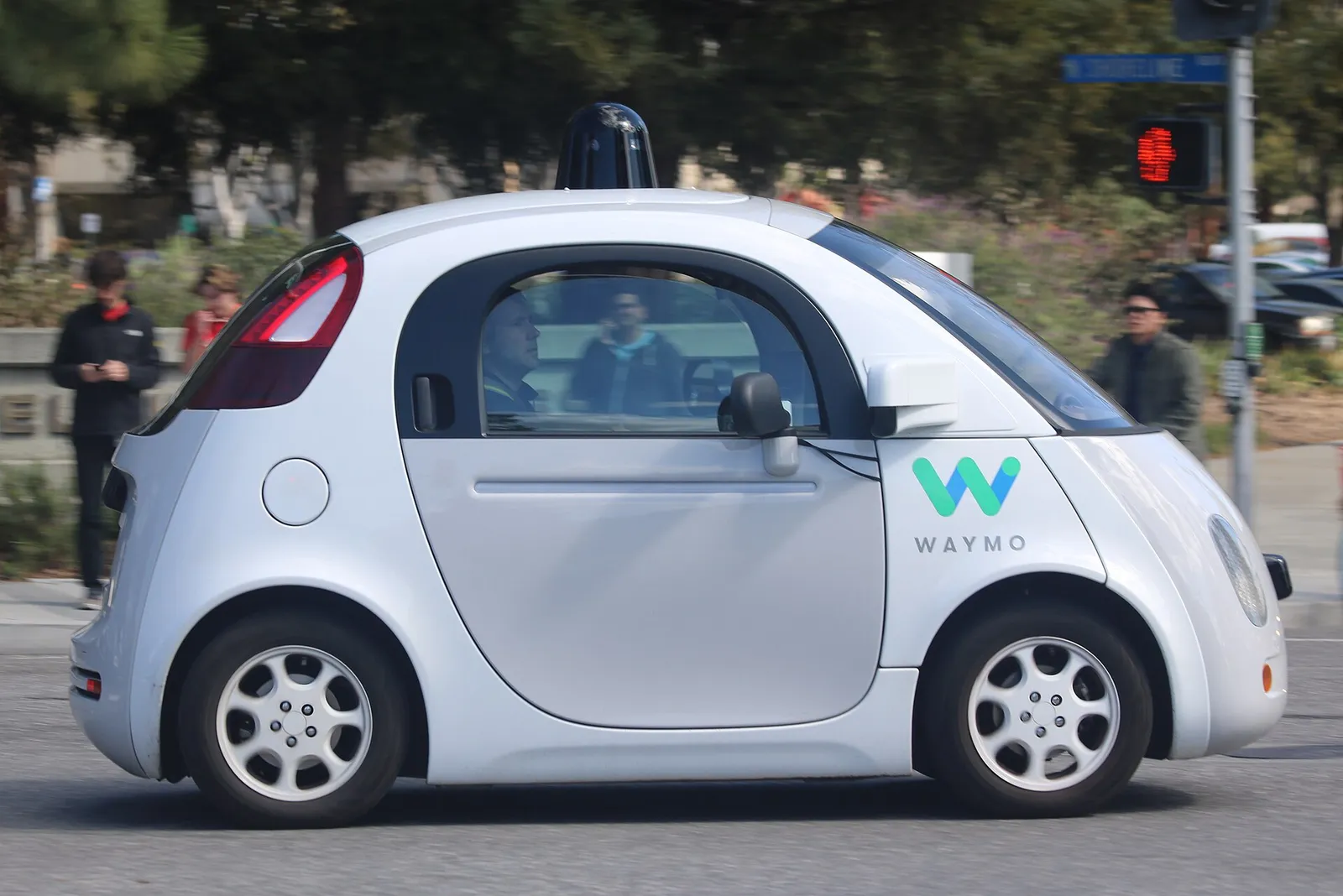
The race to build a driverless taxi business has narrowed to two front-runners with almost opposite strategies — and the one spending the most to win does not build a single car of its own.
What a robotaxi is
A robotaxi is a ride-hailing vehicle — summoned through an app like an Uber — that drives itself, with no human at the wheel. The idea spent two decades in engineering labs; by mid-2026 it is a paid, everyday service in a growing list of American cities.
Two bets
Waymo, a subsidiary of Google parent Alphabet, runs what it bills as the first fully public driverless ride-hailing service, operating across several U.S. metro areas — among them San Francisco, Phoenix, Los Angeles and Austin — with expansion to more than 20 additional cities planned for 2026, including Tokyo and London. The company said it provided 15 million rides in 2025, more than tripling its annual total, and was completing roughly 400,000 rides a week, according to its own disclosures and Bloomberg.
Tesla launched a driverless robotaxi service in Austin in January 2026, charging riders from the start — and aims to scale through a vehicle it manufactures itself.
The sensor divide
The two diverge on the core engineering question: how the car sees.
Waymo's vehicles carry lidar — a sensor that fires laser pulses and times their return to build a precise 3-D map of the surroundings — alongside radar and cameras. Lidar works in darkness and poor weather where cameras struggle, and the overlapping sensors give the system several independent ways to perceive the road. The trade-off is cost: lidar-equipped vehicles have historically been far more expensive to build.
Tesla relies on cameras and neural-network software alone, an approach it calls Full Self-Driving. Chief executive Elon Musk has long argued that cameras plus enough computing power and training data can match human vision at a far lower hardware cost. Critics counter that camera-only systems remain dependent on lighting and can falter on edge cases that sensor fusion handles more robustly. The cost advantage is central to Tesla's pitch: the company has promoted a purpose-built, two-seat Cybercab aimed at a sub-$30,000 price.
The biggest spender builds no cars
By most measures, Alphabet — through Waymo — is the single largest source of capital in autonomous vehicles, and it manufactures nothing itself.
In February 2026, Waymo closed a $16 billion funding round at a $126 billion valuation — the largest investment ever in an AV company, Bloomberg reported. The round was led by Dragoneer, DST Global and Sequoia Capital, with Alphabet remaining the majority backer, and is earmarked for expansion. The valuation is more than double the roughly $45 billion Waymo commanded after its prior raise in late 2024.
Waymo owns its fleet but builds none of it: partners such as Jaguar manufacture the vehicles, which are then fitted with sensors and software. Its next-generation robotaxi is being co-developed with Chinese automaker Zeekr, a Geely brand, explicitly to lower per-vehicle cost. The model resembles a technology owner sitting atop a traditional auto supply chain.
Tesla's model is the mirror image: it builds its own cars at scale, plans to produce the Cybercab, and intends to let private owners add their vehicles to a Tesla-run network when idle — a potentially capital-light way to expand the fleet.
Economics and the road ahead
Neither company has set a public date for profitability. Waymo's average fare in the San Francisco Bay Area ran about $19.69 over a recent stretch, above Uber's $17.47 and Lyft's $15.47, TechCrunch found — though the gap has been narrowing. Waymo says it has driven more than 200 million fully autonomous miles and reports far fewer injury crashes than human drivers in its service areas, figures the company publishes itself and that have not been independently audited.
The strategic question for investors is which model reaches sustainable economics first. Tesla's vertical integration could drive down per-mile costs if its camera-only autonomy proves out at scale — still unproven. Waymo's sensor-heavy system is operationally further along but capital-intensive and reliant on partners to keep vehicle costs falling. The history of the field is littered with well-funded failures — General Motors' Cruise, and Ford and Volkswagen's Argo AI among them — a reminder that deep pockets have not, on their own, been enough to finish the race.