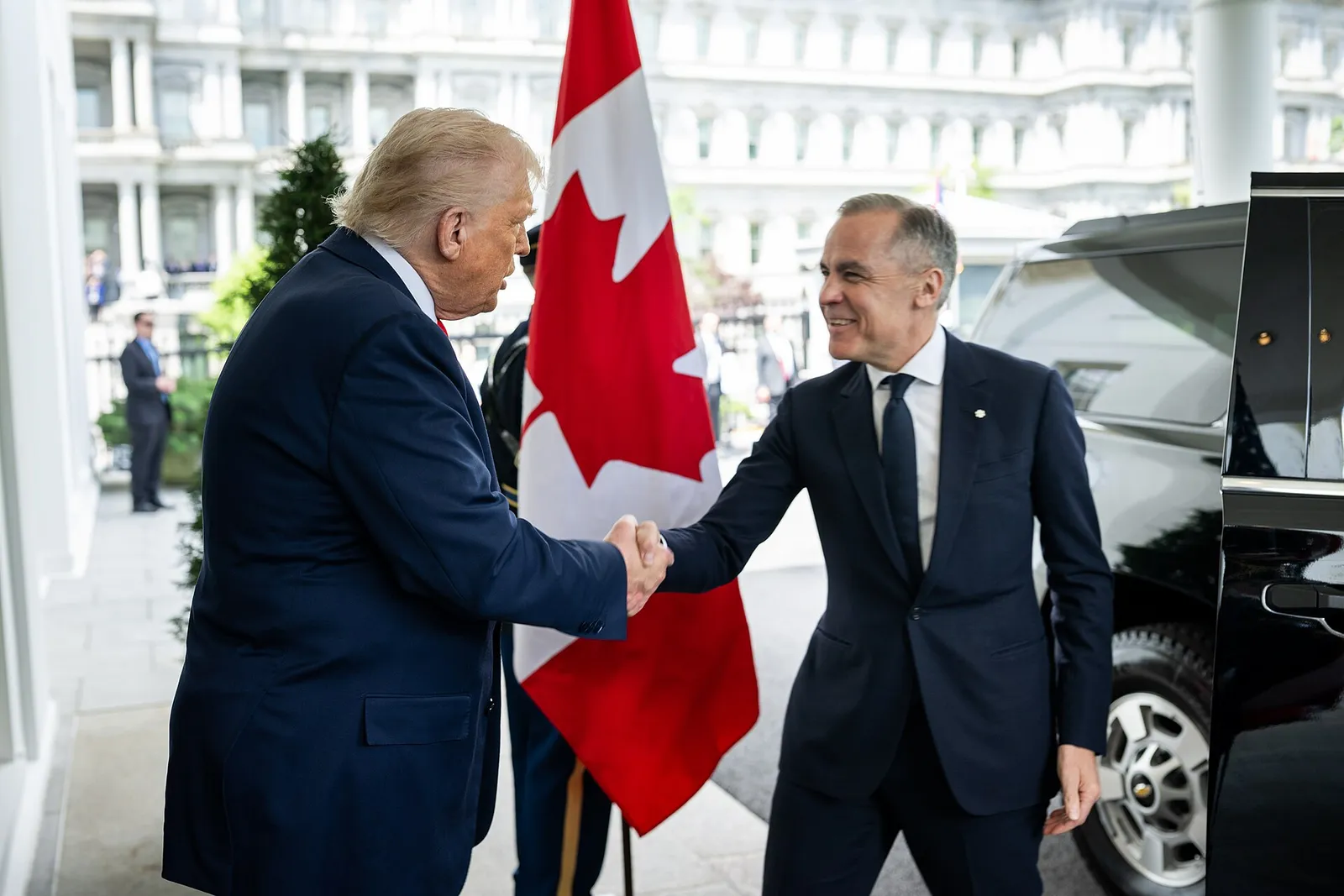
China's diplomatic calendar this year tells an economic story: while Washington wields tariffs, Beijing is rolling out the red carpet.
The open door
Since January, Xi Jinping has received at least 15 heads of state or government in Beijing, per Al Jazeera's tally of foreign-ministry readouts — from European leaders to Russia's Vladimir Putin (and, separately, a state visit by President Trump in May). China has framed each in the language of stable, "multipolar" trade, an implicit contrast with what it casts as U.S. unilateralism. (Broader counts circulate that are higher; we use the figure confirmable from official readouts.)
What "middle powers" means
The term covers countries big enough to have leverage but unwilling to anchor themselves to one superpower — Indonesia, Brazil, Saudi Arabia, South Africa, Malaysia, Vietnam, India. Their strategy is hedging: keep deep ties with both the U.S. and China rather than choose. "Countries are pursuing diversification away from the United States rather than a direct pivot toward China — they are engaging with both," Steve Okun of APAC Advisors told reporters. India's foreign minister calls it keeping "multiple options" — multi-alignment, not neutrality.
The economic math
The catalyst is tariffs. The Trump administration's 2025 trade package pushed the average U.S. tariff to about 17.3%, the highest since 1935, per the Tax Foundation, with steep country rates that hit export-dependent economies like Vietnam hard. China has moved the other way: it extended zero tariffs to all 53 African nations with diplomatic ties, deepened its free-trade pact with ASEAN, and its Belt and Road investment hit a record of roughly $213 billion in 2025. "China offers market size and industrial depth" and "long-term policy consistency," Eurasia Group's Dan Wang noted, against a U.S. whose "policies can swing every election cycle."
The trade is already rerouting: ASEAN exports to the U.S. jumped sharply through late 2025 as manufacturers shifted production out of China to lower-tariff hubs like Vietnam and Malaysia — a reshuffle that benefits the middle powers caught in between.
The limits
This is hedging, not abandonment, and analysts caution against overstating it. The U.S. still dominates global finance, technology standards and security in ways no Chinese institution replicates; Saudi Arabia has pointedly declined formal BRICS membership to preserve its Washington ties. China's own pull is constrained by a slowing economy, a stressed property sector, and a record of coercive trade episodes (rare-earth curbs, informal sanctions) that dent trust. Talk of de-dollarization runs ahead of reality — no unified BRICS currency is in active negotiation, and headline claims about national-currency trade settlement are unverified. A 2026 CSIS survey found only about a quarter of experts think U.S.–China relations are more stable than a year ago.
The investor read
For supply-chain strategists, the takeaway is a more fragmented but not fully split trading system — one where middle powers extract value from both sides rather than subordinate to either. That means more diversified sourcing, more regional trade blocs, and more currency and political risk to price in. Whether the equilibrium holds depends on whether U.S. tariff policy stabilizes, whether China's growth recovers, and whether either side's preferred institutions can enforce any rules at all. This is analysis of a shifting order, not a prediction of where it lands.