This is general information, not investment advice.
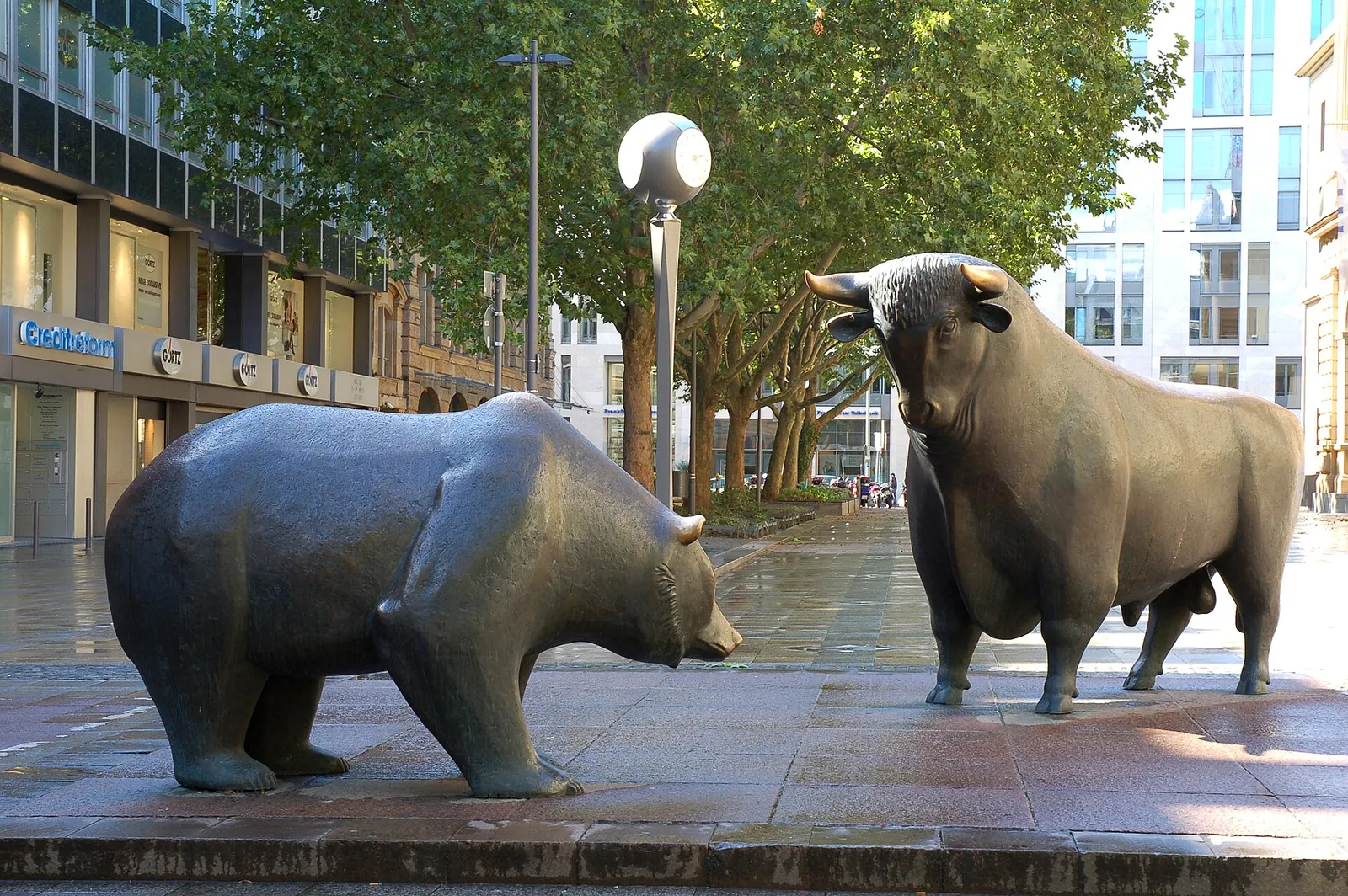
When markets fall, the labels matter — each signals a different severity and has a different track record.
The vocabulary
- Correction: a decline of 10% or more from a recent peak. The mildest label, and common — most corrections don't escalate. Going back to 1975, only six of 27 S&P 500 corrections turned into bear markets, per Fidelity.
- Bear market: a decline of 20% or more from a recent peak, sustained over time. This is the widely used convention for indexes like the S&P 500.
- Crash: not a fixed percentage but a matter of speed — a sudden, steep drop over days or a single session. "Black Monday" in October 1987 saw the Dow fall more than 22% in one day. A bear market can grind out over months; a crash happens in hours.
- Bull market: the opposite — a sustained rise, often defined as a 20% gain from a recent low.
How often, how deep, how long
History gives rough averages. There have been 27 bear markets in the S&P 500 since 1928 — about 15 since World War II, or roughly one every five years — according to Hartford Funds. The average bear has lasted about 9.6 months and cut prices by roughly 35%. Bull markets, by contrast, have run far longer — averaging about 2.7 years with average gains around 112% — which is why stocks have spent the large majority of the past century rising, not falling.
Where the labels apply
These thresholds apply to a broad index or to a single stock. A single company's shares can be deep in a bear market (down 40%+) while the index is still rising — exactly what's happening now with parts of the AI trade. When people say "the market" is in a bear market, they usually mean a major index; applied to one stock, it's the same math on that security.
Terms worth knowing
- Drawdown: the peak-to-trough decline — how far an index or portfolio has fallen from its high.
- Capitulation: the point, often near a bottom, when holders finally give up and sell in volume. Historically it has sometimes preceded recoveries — but timing it is notoriously hard.
- Bear-market rally: a temporary bounce within a downtrend that can fool investors into thinking the worst is over. Tellingly, a large share of the market's best single days have occurred during bear markets.
Cyclical vs. secular
A cyclical bear is tied to the business cycle — a recession, a rate-hike cycle, a shock — and usually resolves within months to a couple of years. A secular bear is a longer regime of flat or negative real returns spanning years, even with sharp rallies along the way (U.S. stocks in 1966–1982 are a common example).
What history shows about recovery
Every U.S. bear market so far has eventually ended, and markets have gone on to new highs — though the timing varies widely, and past performance doesn't guarantee future results. Notably, bear markets don't always come with recessions: there have been more bears than recessions since 1928. What history and financial advisers broadly emphasize is that downturns are a normal, recurring part of investing, and that missing the market's best days — many of which cluster in and just after bear markets — has historically been costly. Whether the right response is to stay invested, rebalance, or something else depends on an individual's time horizon and circumstances. This is an explainer, not advice.