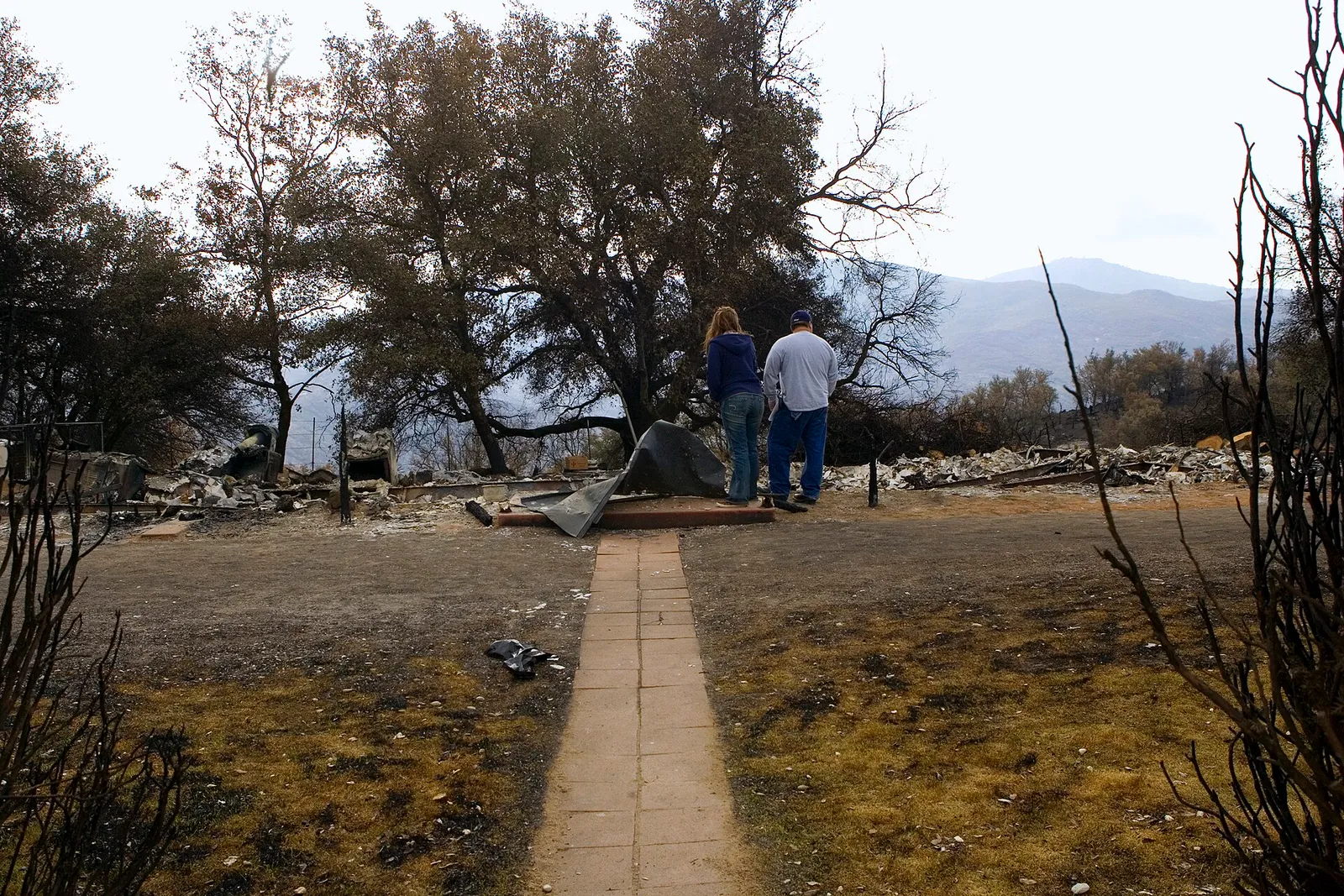
Gavin Newsom has put a wildfire liability package in front of the California legislature with a deadline of 31 August, and has said he may call a special session if nothing passes.
The fund at the centre of it was created in 2019, holds $21 billion paid in by utility shareholders and ratepayers, and is expected to run out soon. An $18 billion supplement was approved by the legislature last year.
What is actually being proposed
Five things, and they do not all point the same way.
Insurance companies would cover more property damage costs. Utility chief executives would forfeit bonuses if their company sparks a fire causing more than $1 billion of damage. Utility shareholders could be fined up to $10 million for wildfire prevention violations. Payouts to victims from utilities would be accelerated. And the amounts electric and gas companies must pay victims and their attorneys would be limited.
The first and last are the load-bearing ones. Moving cost onto insurers and capping what utilities owe are the same decision viewed from two sides, and together they describe a transfer of liability away from the three investor-owned utilities: PG&E, Southern California Edison and San Diego Gas & Electric.
Note what the accelerated-payout provision does to the politics. Victims are offered speed, which is real and valuable, in a package that also limits the total. Whether that is a fair exchange depends on numbers that are not in the proposal as reported.
Why the fund is running out
Two fires explain most of it. PG&E equipment started the 2018 Camp Fire, which killed 85 people and destroyed more than 18,000 buildings. A Southern California Edison transmission tower was involved in the 2025 Los Angeles fire, in which 19 people died.
A fund sized in 2019 for the risk as it was then understood has met a decade of losses in seven years. That is the fiscal fact underneath the legislative deadline, and it is the same pattern we described in the climate insurance squeeze becoming an economic problem: the historical loss distribution has stopped predicting the current one, and every mechanism priced off the old distribution runs short.
Four positions, stated by the people holding them
Newsom: "Status quo is not going to work. It's not going to work for victims, who consistently are last in line."
Joy Chen of Every Fire Survivor's Network calls it "overall a massive transfer of liability for the three for-profit utility monopolies."
Rex Frazier, president of the Personal Insurance Federation, whose members would absorb more of the cost: "Being responsible for your actions is something that parents tell children."
Meredith Fowlie, an economist at UC Berkeley, supplies the complication both sides skip: "Utilities can start fires, but they don't by themselves create catastrophe."
That last one is the analytically serious point in the debate. Ignition is one input. What turns an ignition into a catastrophe is where people built, how dry the fuel is, how the wind behaves and what the building codes required. A liability system that assigns the whole cost to whoever supplied the spark is charging one party for a risk that several parties created, which is why the argument keeps returning regardless of who is in office.
What this decides beyond California
Whether an investor-owned utility can carry catastrophe risk at all.
If the answer is that it cannot, the cost lands somewhere: on insurers, who will price it and in some markets decline to; on ratepayers, through the bills; on taxpayers, through a state fund; or on homeowners, through uninsured losses. Those are the only four places it can go, and every proposal is a choice among them dressed in different language.
California is the first large jurisdiction to have to make the choice explicitly. It will not be the last, and the mechanism it settles on by 31 August is the one others will copy or avoid.
One caveat on the reporting: the account available to us does not specify what legal rights, if any, claimants would give up under the proposal, and we have not characterized that.