This is general information, not investment advice.
Quantum computing fills corporate keynotes and venture pitches. Stripped of hype, here's what it actually is — and the one corner of finance where it genuinely matters.
What it is, in plain terms
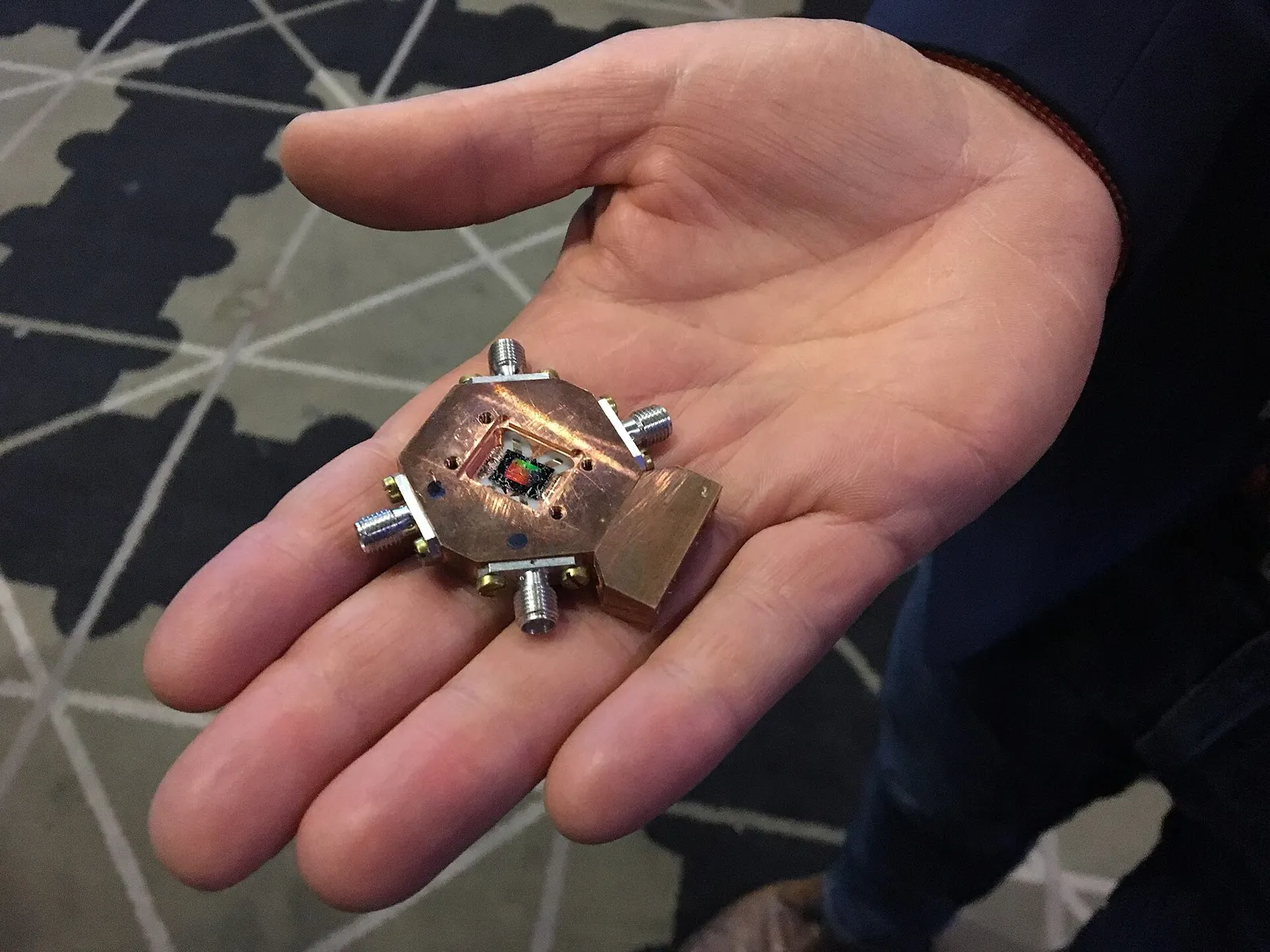
A classical computer stores information in bits that are either 0 or 1. A quantum computer uses qubits, which exploit two quantum properties. Superposition lets a qubit represent a blend of 0 and 1 at once, not one fixed value. Entanglement links qubits so their states are correlated — measuring one instantly constrains the others. Together, as IBM explains, these let a quantum machine explore many possibilities in parallel for certain problems. (IBM's qubits are tiny superconducting circuits chilled to near absolute zero.)
What it is not
A quantum computer is not just a faster laptop. It helps only on specific problems — optimization among vast combinations, simulating molecules and materials, and certain math like factoring large numbers. For everyday tasks it's no better, often worse. The eye-popping milestone figures — Google's 2019 "supremacy" claim, or its 2024 Willow chip beating a "10²⁵ years" benchmark — apply to contrived tasks with no practical use (Google says as much). What made Willow notable, in a peer-reviewed Nature result, is that adding qubits reduced the error rate — a long-sought sign that error correction can scale.
The hard part: errors
There's no clear hardware winner. IBM and Google use superconducting qubits (most qubits, fast, but error-prone); IonQ and Quantinuum use trapped ions (longer-lived, fewer errors, harder to scale); Microsoft is chasing an exotic "topological" qubit whose 2025 claim is disputed. The central obstacle is error correction: qubits are fragile, losing their state through decoherence in microseconds, and operations still fail often. That's why today's machines are called "noisy" and remain limited — and why a genuinely useful, fault-tolerant machine is, on most roadmaps, years away.
Where finance is interested
Banks see potential in portfolio optimization, risk/Monte Carlo simulation, derivatives pricing and fraud detection. JPMorgan has an active research group (publishing option-pricing and certified-randomness results); Goldman Sachs ran a quantum Monte Carlo proof-of-concept with QC Ware and IonQ in 2021. But these are experiments — as of 2026, no major bank runs quantum hardware in production. Consultancies are bullish long-term (McKinsey projects $400–600bn of value for finance by 2035; BCG $450–850bn across industries by 2040) — but those are wide projections, not measured results, and we flag them as such.
The real risk: cryptography
The sharpest concern is security. Much of banking, the internet and crypto wallets rely on public-key encryption — RSA and elliptic-curve — whose safety rests on math that's hard for classical computers. In 1994, Peter Shor showed a powerful quantum computer could crack exactly those problems: Shor's algorithm would, in principle, break today's standard encryption. No machine can do this yet (estimates run to millions of error-corrected qubits, though recent papers suggest fewer). The nearer worry is "harvest now, decrypt later" — adversaries copying encrypted data today to crack once the hardware exists, a risk the Federal Reserve has analyzed for ledger networks.
The response is post-quantum cryptography — new algorithms believed resistant to quantum attack. In August 2024, NIST finalized its first three standards (with a fourth added in 2025), and is urging organizations to begin migrating off RSA and elliptic-curve cryptography over the coming decade.
The reality check
Most experts think a "cryptographically relevant" quantum computer is years to a decade-plus away, with no consensus — a widely cited Global Risk Institute survey puts the odds at roughly even by about 2035. Boursel has noted that several flashy quantum claims were challenged soon after publication. The takeaways: investors should separate durable engineering progress from benchmark theater; and institutions' actionable step isn't buying a quantum computer but inventorying their cryptography and planning the migration to post-quantum standards — work that can start now, whenever the hardware arrives.