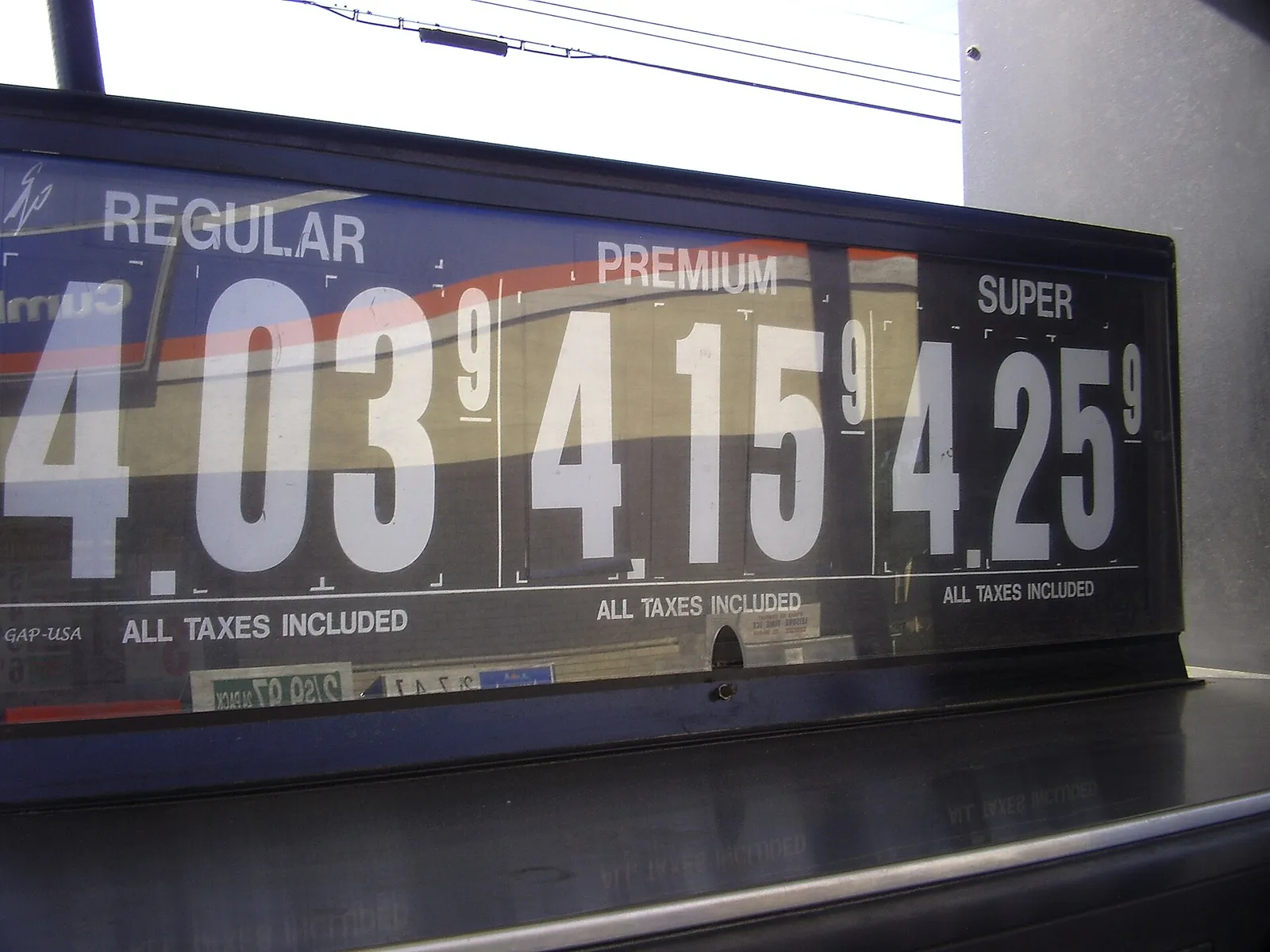
Gas is getting expensive again, quickly. The US national average hit about $4.09 a gallon this week, after rising 25 cents for the second straight week, as supply concerns around the Strait of Hormuz outweighed crude prices dipping below $100 a barrel, according to AAA. The pain is uneven: the same data puts California at $6.16 a gallon while Oklahoma drivers pay $3.98.
Rising prices add up fast at the household level. NerdWallet found that higher pump prices have added at least $10 a week to drivers' spending in 36 states since late February, roughly $520 a year if the increase holds. So it is reasonable to ask: is it worth driving out of your way for a cheaper station?
Run the numbers before you drive
The arithmetic takes thirty seconds. Suppose your car holds 15 gallons and gets 25 miles per gallon, and a station three miles away sells gas 15 cents cheaper than the one on your corner.
- What you save: 15 cents × 15 gallons = $2.25 on a full tank.
- What the detour costs: a 6-mile round trip at 25 mpg burns about 0.24 gallons, roughly $0.98 at $4.09 a gallon.
- Net gain: about $1.27, before counting your time.
Do that weekly and you have saved about $66 in a year, real money, but modest for the effort. Shrink the discount to a nickel and the same detour loses money. The general rule: a small discount only beats the cost of getting there when the detour is very short, and a long detour only pays when the per-gallon gap is large or your tank is big.
The savings that don't require a detour
The better version of price-shopping is opportunistic, not dedicated. Price-comparison apps such as GasBuddy and Upside, which NerdWallet points to for finding discounts nearby, are most useful for choosing the cheapest station already on your route, where the driving cost of the "detour" is zero. Even 10 or 20 cents a gallon adds up when it is free to capture.
Stacking helps too: station loyalty programs commonly knock cents off per gallon, and gas-rewards credit cards return a few percent on fuel purchases, savings that apply on every fill-up regardless of where you buy.
And the least glamorous lever is the car itself. The Department of Energy's fuel-economy guidance says keeping tires at the recommended pressure can improve mileage by up to 3%, with basic maintenance such as clean air filters and proper alignment adding more. At $4.09 a gallon, a 3% efficiency gain is worth about 12 cents per gallon, comparable to the discount many people drive across town to get.
The bottom line
Chasing cheap gas is not a myth, but it is a math problem, and the variables are the size of the discount, the length of the detour and your car's efficiency. Capture the discounts that cost nothing to reach, stack loyalty and card rewards, keep the tires inflated, and save the cross-town drive for the rare case when the numbers genuinely clear the bar.