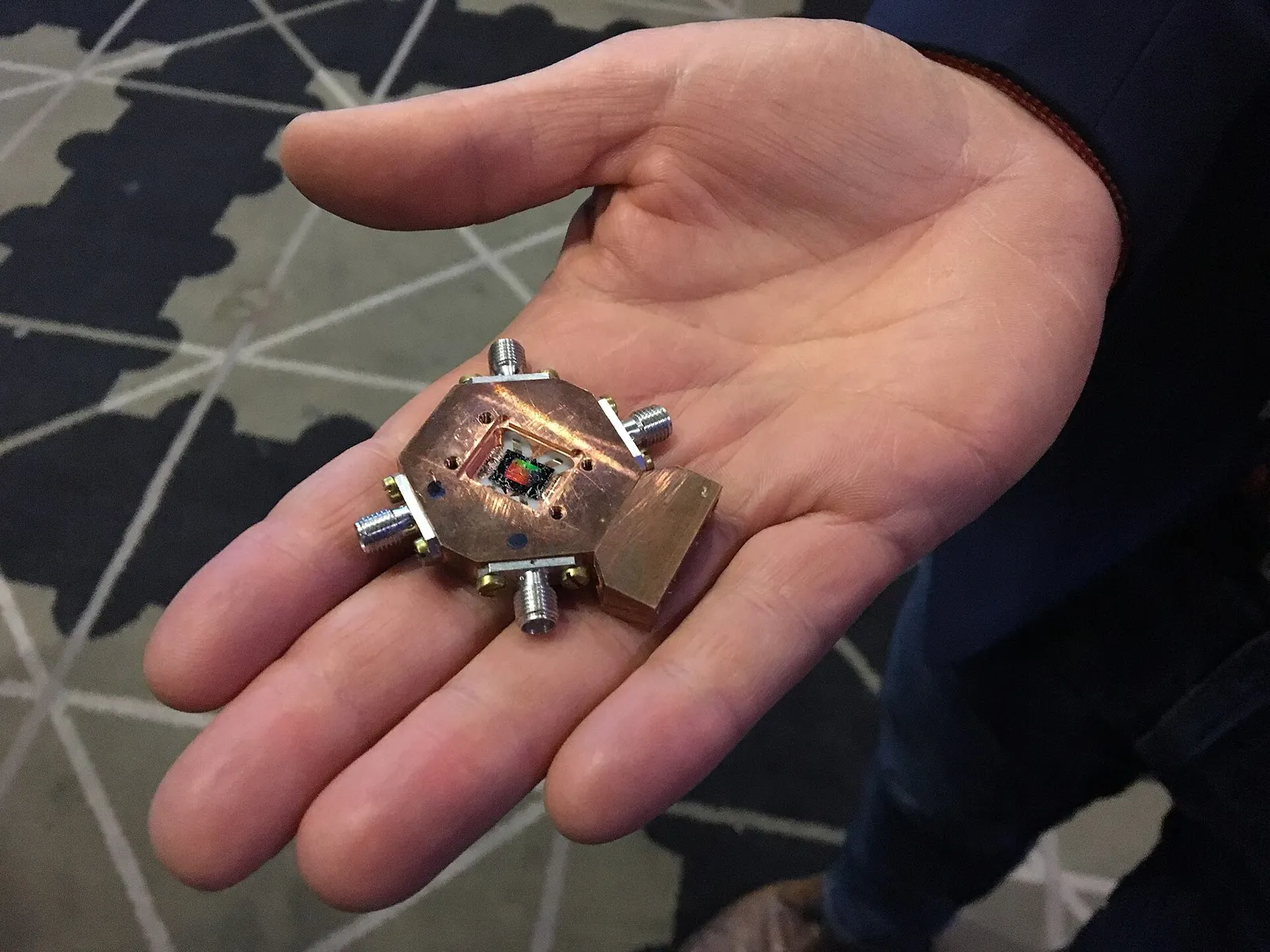
When Microsoft unveiled its Majorana 1 chip in February 2025, it called the device the world's first quantum processor built on "topological" qubits and pitched it as a path toward a million qubits on a single chip. More than a year later, the claim is under formal challenge in the same journal that published the underlying research.
Henry Legg, a physicist at the University of St Andrews, has published a critique in Nature's "Matters Arising" section — the journal's designated venue for peer-reviewed criticism of papers it has previously published, according to Scientific American. Legg argues that nothing in Microsoft's data establishes that the company has created or controlled the exotic quantum states its strategy depends on.
What a topological qubit is supposed to do
Ordinary quantum computers store information in qubits, which can represent 0, 1, or a blend of both at once. Their weakness is fragility: heat, vibration and electrical noise can corrupt them almost instantly, forcing today's machines to spend enormous resources on error correction.
A topological qubit aims to sidestep that fragility by encoding information non-locally — spread across a pair of so-called Majorana states at the ends of a specially engineered nanowire, rather than in a single, easily disturbed location. If such states can be reliably created and measured, they could in principle make qubits far more stable and dramatically cut the error-correction overhead. That "if" has been the crux of Microsoft's two-decade research program, and the reason rivals such as Google and IBM, which use superconducting qubits, have watched it closely.
The dispute over the evidence
Legg's critique centers on Microsoft's "topological gap protocol," the in-house test the company uses to decide whether a device has entered the desired quantum state. He argues the protocol is prone to false positives — that ordinary electronic noise and disorder in the material can produce signatures that resemble the real thing, Scientific American reported. His analysis describes measurements taken in regions of the device that appear disordered rather than cleanly "gapped," and points to omitted data and analysis errors that, he contends, obscured alternative explanations.
This is not the first time Microsoft's Majorana work has drawn scrutiny. Outside physicists have questioned the company's claims for years, and Microsoft retracted earlier Majorana-related papers in 2018 and 2021 — a history that has left independent researchers cautious about new announcements.
Microsoft's response
Microsoft is not backing down. In a reply published alongside the critique in Nature, the company said its measurements of an indium-arsenide and aluminum nanowire device are consistent with its theoretical model and strongly constrain non-topological explanations. The company has also pointed to external validation, noting that the U.S. Defense Advanced Research Projects Agency advanced its program in a competitive quantum benchmarking effort after evaluating the results.
The exchange arrives as Microsoft promotes a successor chip, Majorana 2, and reaffirms a roadmap that aims for a scalable, practical quantum computer by the end of the decade.
Why it matters beyond physics
The argument is technical, but the stakes are commercial. Microsoft has presented topological qubits not just as a scientific milestone but as a structural cost advantage — a way to reach useful quantum computing with far less hardware than competing approaches require. If the underlying physics holds, that could differentiate Microsoft in a field where every large technology company is now investing.
If it does not — if the signatures Microsoft has reported turn out to be artifacts — then a central piece of its quantum strategy, and the public timeline built around it, would need rethinking. For investors trying to value Big Tech's quantum ambitions, the distinction between a genuine hardware breakthrough and a contested measurement is precisely the question this Nature exchange leaves open.