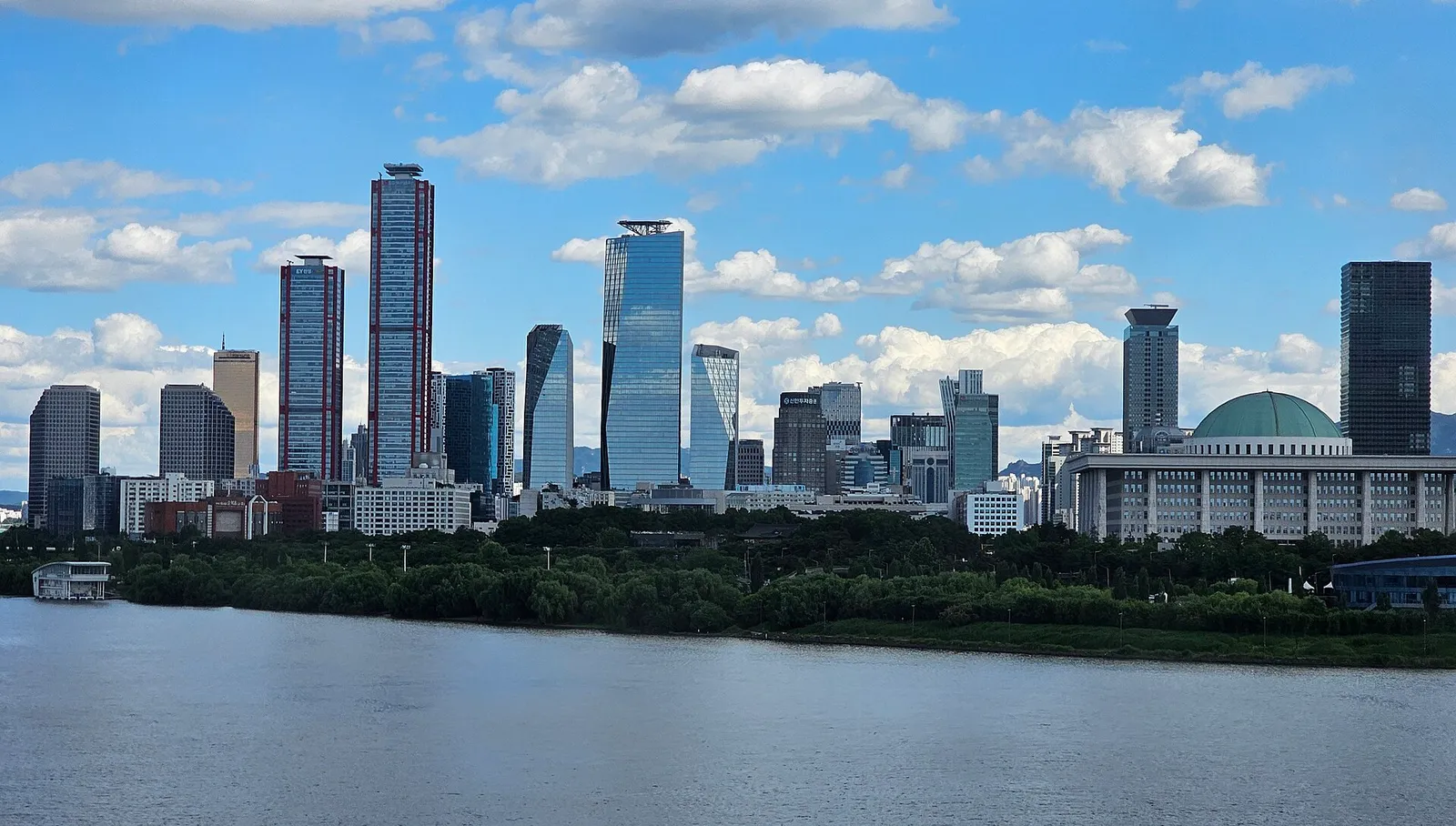
South Korea's stock market spent the first half of 2026 as the best performer in the world. It has spent the past month demonstrating why that was not straightforwardly good news.
The Kospi is now around 25 percent below the record high it set on June 19, a drawdown that has erased roughly $1 trillion of market value, according to Bloomberg data reported this week. The index is nevertheless still up about 62 percent for the year, which captures how extraordinary the preceding rally was.
Two companies, half an index
The explanation for both the ascent and the fall is concentration.
Samsung Electronics and SK Hynix together accounted for more than half of the Kospi's weighting as of June, according to data from Emmer Capital cited by CNBC. No other major developed market is anything like this concentrated. Both companies make high-bandwidth memory, the stacked memory that sits beside AI accelerators in data centers.
A brief explanation of why that matters. Training and running large AI models is limited less by raw processing speed than by how fast data can be fed to the processor. High-bandwidth memory addresses that by stacking memory chips vertically and placing them next to the processor, widening the pipe. It is a component with few credible suppliers, and Korea houses most of them.
The consequence is that an index which is nominally a broad measure of the Korean economy behaves in practice like a concentrated position in AI memory demand. When the market revises its view of how much will be spent on AI infrastructure, Seoul revises faster and further than anywhere else.
The drawdown was about positioning, not earnings
What makes this episode instructive is that it did not follow bad results.
Samsung reported blockbuster profit in the same week the index fell into bear market territory, and memory pricing has continued to strengthen. The shares fell anyway, on concerns about the durability of AI capital spending rather than about the quarter just reported.
Analysts describe the move as a repricing of crowded positioning. "The correction has been driven more by positioning than by a deterioration in fundamentals," said Jung In Yun, founder of Fibonacci Asset Management Global, who added that Korean equities had become "one of the most crowded AI trades globally after a very strong rally, so it did not take much to trigger profit taking." He characterized the fall as "a healthy reset rather than a fundamental change in the outlook."
Manishi Raychaudhuri, chief executive of Emmer Capital, attributed the drawdown to "heightened AI skepticism on the part of global investors, coupled with extreme market concentration."
There is also a structural argument about how markets now move. Peter Kim, global investment strategist at KB Financial Group, said "the gamification of finance has led to such gyrations driven less by fundamentals but by news flows and fads," pointing to retail flows, leveraged exchange-traded funds and AI concentration as reasons that swings of 5 to 10 percent have become common. The Kospi volatility index has risen more than 200 percent since the start of the year.
The coupling with US tech has tightened
The reason this matters beyond Korea is that the relationship with US technology stocks has become much closer.
The 60-day correlation between the Kospi and the Nasdaq 100 has reached 0.46, against a five-year average of 0.16, according to the Bloomberg analysis. The same work found the Nasdaq 100's sensitivity to below-trend Kospi returns recently climbed to its highest level since 1990.
A correlation of 0.46 is far from lockstep, and these statistics are sensitive to the window chosen. But the direction is clear: two markets that used to move largely independently are now substantially driven by the same variable, which is the expected path of AI infrastructure spending. Because Seoul trades while New York sleeps, that gives the Kospi an informational role it did not previously have.
What to take from it
For investors outside Korea, the practical use is as an indicator rather than a destination. Seoul offers an early, high-sensitivity reading on AI sentiment, for precisely the reason it is risky to hold: the index is dominated by two firms selling into one demand story.
The caution is symmetrical. An index that amplifies optimism amplifies its withdrawal, and a 25 percent drawdown arriving on top of blockbuster earnings is a reminder that the market is pricing expectations about spending years ahead, not results already banked. Nothing in the past month settles whether the AI build-out continues at pace. It only shows how quickly the price of assuming it can change.