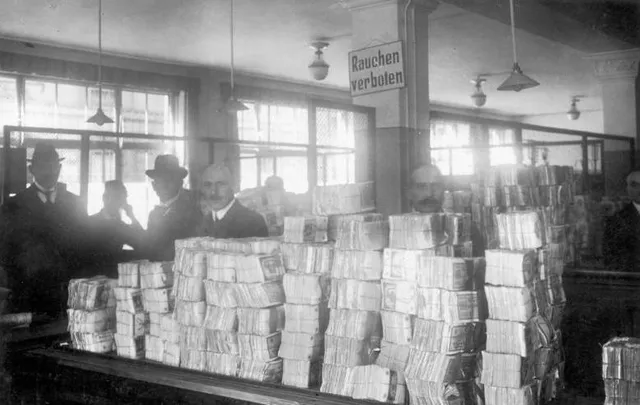
Ordinary inflation nibbles at the value of money. Hyperinflation devours it. In the worst episodes, prices have risen so fast that workers were paid twice a day and spent their wages immediately, before they lost value by evening. Understanding how a currency can spiral to worthlessness explains why central banks fear inflation so much.
What hyperinflation is
Hyperinflation is an extremely rapid, out-of-control rise in prices — inflation not of a few percent a year but of enormous rates over very short periods, as Investopedia defines it. A common technical benchmark, from economist Phillip Cagan, sets the threshold at inflation exceeding 50% per month — which compounds to prices rising many times over within a single year, a standard reference point.
At those speeds, money stops doing its job. It can no longer reliably store value or even measure prices, because the price changes hour to hour.
How it happens
Hyperinflations are rare, and they usually share a cause: a government printing money to cover spending it cannot otherwise fund — often amid war, political collapse, huge debts or the loss of productive capacity. When a state creates money far faster than the economy produces goods, too much currency chases too few goods, and prices explode.
Crucially, it becomes self-reinforcing through psychology. Once people expect prices to keep soaring, they spend cash the instant they get it and demand ever-higher wages and prices — which pushes prices up faster still. Confidence in the currency evaporates, and its collapse feeds on itself. Hyperinflation is as much a crisis of trust as of economics.
The infamous examples
History's cautionary tales are vivid:
- Weimar Germany, 1923. Crushed by war debts and reparations, Germany printed money until prices doubled every few days. People famously carried banknotes in wheelbarrows and burned them for warmth, cheaper than firewood.
- Zimbabwe, late 2000s. Economic collapse and money-printing produced almost incomprehensible inflation; the central bank issued a 100-trillion-dollar note before the currency was abandoned entirely around 2009.
- Hungary, 1946, is generally regarded as the worst hyperinflation ever recorded, with prices at one point roughly doubling within a day.
What it destroys
The human cost is severe. Hyperinflation wipes out savings — a lifetime's cash holdings can become worthless in weeks. It ravages anyone on a fixed income or wage, devastates lenders (repaid in near-worthless money), and pushes economies toward barter or foreign currencies as people abandon the failing one. It has toppled governments and helped set the stage for political extremism.
How it ends
Hyperinflations are usually broken only by drastic measures that restore trust: stopping the money-printing, often introducing a new currency, imposing fiscal discipline, and sometimes anchoring to a stable foreign currency or hard asset. The fix is as much about credibility as arithmetic — convincing people the authorities will no longer debase the money.
Why it matters
For economies, hyperinflation is the extreme that explains the ordinary: it is precisely because runaway inflation is so destructive that central banks guard price stability so jealously, and why even moderate inflation is taken seriously. For savers and investors, it is the ultimate reminder that cash is only as trustworthy as the institution behind it. And for understanding money itself, hyperinflation reveals a deep truth: a currency has value only because people believe it does — and when that belief breaks, it can break completely. Boursel gives no investment advice; the takeaway is that stable money is a hard-won achievement, not a given — and its collapse is one of the most damaging events an economy can suffer.