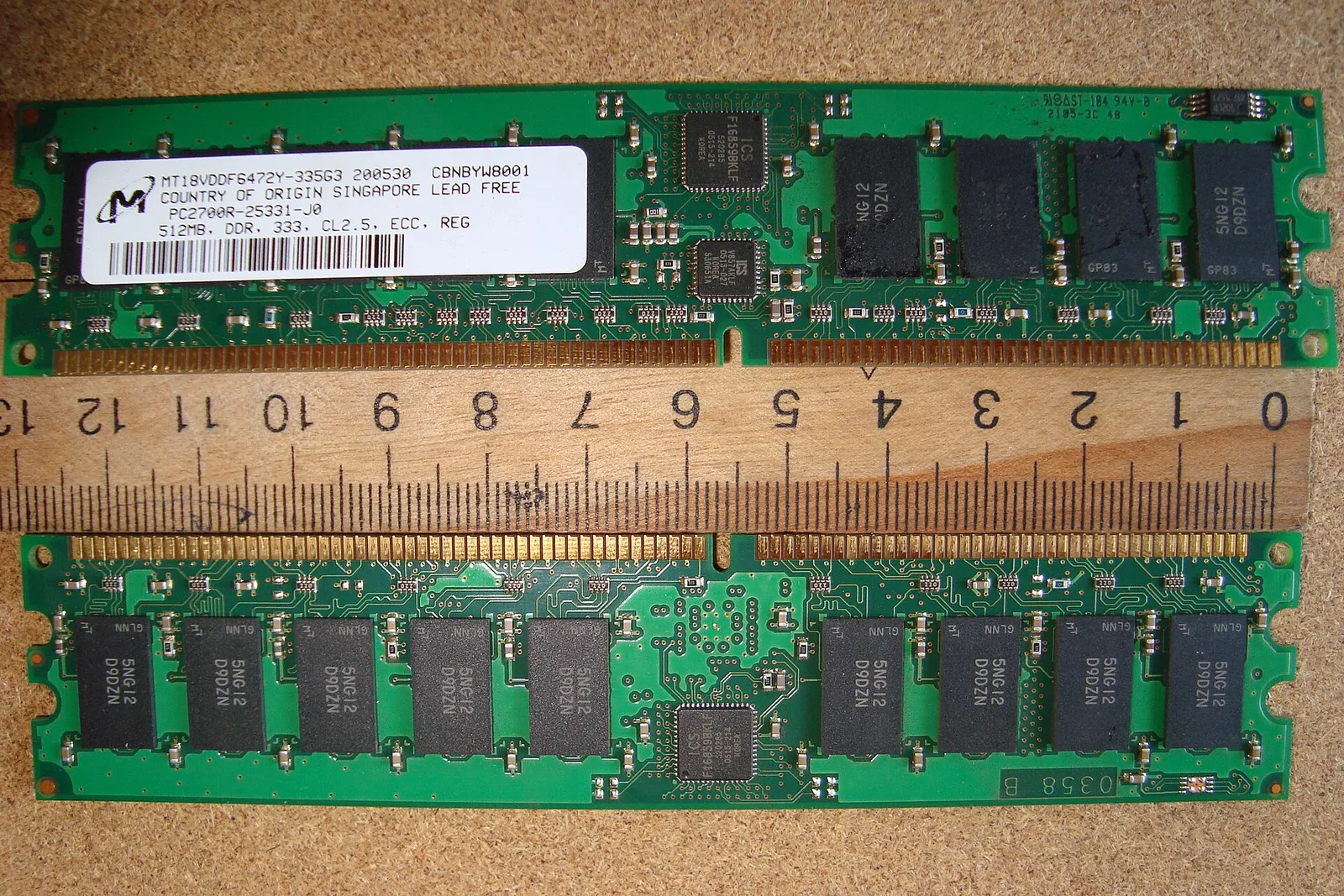
The AI boom has turned a boom-and-bust commodity into a gold mine. Micron — the largest US maker of memory chips — reported quarterly revenue of about $41.5 billion, up from just $9.3 billion a year earlier, the company said. Net income topped $28 billion, operating margins ran above 80%, and Micron guided to roughly $50 billion in revenue next quarter — extraordinary figures for a business that was losing money two years ago.
From glut to shortage
To understand the swing, you have to understand the memory cycle. Memory chips — DRAM (a computer's short-term working memory) and NAND flash (storage) — are made by just a few firms (Micron, Samsung and SK Hynix) and behave like a commodity: when there's a glut, prices crash; when supply is tight, they spike.
After 2022, the industry drowned in oversupply. Prices collapsed — to a fraction of prior levels — and customers, sitting on excess inventory, squeezed suppliers hard on price. So the chipmakers did what commodity producers do in a bust: they slashed investment in new capacity. Micron's CEO Sanjay Mehrotra argues that this is exactly why the market is now short: years of "customers driving a hard bargain on price," as he put it, left the industry without enough capacity when demand suddenly roared back.
Enter AI
What roared back was artificial intelligence. AI accelerators — above all Nvidia's chips — need vast amounts of high-bandwidth memory (HBM), a premium type of memory stacked right next to the processor to feed it data fast enough. A single AI GPU uses many HBM chips, and AI data centers now soak up a large share of the world's high-end memory.
To chase that demand, memory makers have shifted capacity toward HBM and away from ordinary chips — tightening supply of everything and handing pricing power back to the producers. Micron has said it can currently satisfy only half to two-thirds of total DRAM demand, Tom's Hardware reported, and industry executives expect the crunch to persist into 2027. Memory prices have surged as a result.
(Explainer: HBM — high-bandwidth memory — is the specialized, high-margin memory that makes AI chips run; it's the corner of the market growing fastest.)
The other side of the AI-hardware story
Micron's windfall completes a picture Boursel has been tracing. Nvidia captures the fattest profits in AI chips; box-builders like Dell run on thin margins; and now the memory makers — long the volatile weak link — have become big winners too, because their product is a genuine bottleneck. New factories are being built (in the US and Asia), but fabs take years to come online, so scarcity is likely to linger.
Why it matters
For Micron and its rivals, the shift means fat profits and pricing power after years of pain — though the cycle always eventually turns, and today's building boom could seed the next glut. For the AI industry, expensive, scarce memory is another cost and constraint on the buildout, alongside power and advanced chips. And for everyone else, tight memory can quietly raise the price of PCs, phones and servers, since those devices all need it. Boursel offers no view on Micron's stock; the takeaway is that in the AI gold rush, memory has gone from afterthought to chokepoint — and the companies that make it are, for now, in the driver's seat.