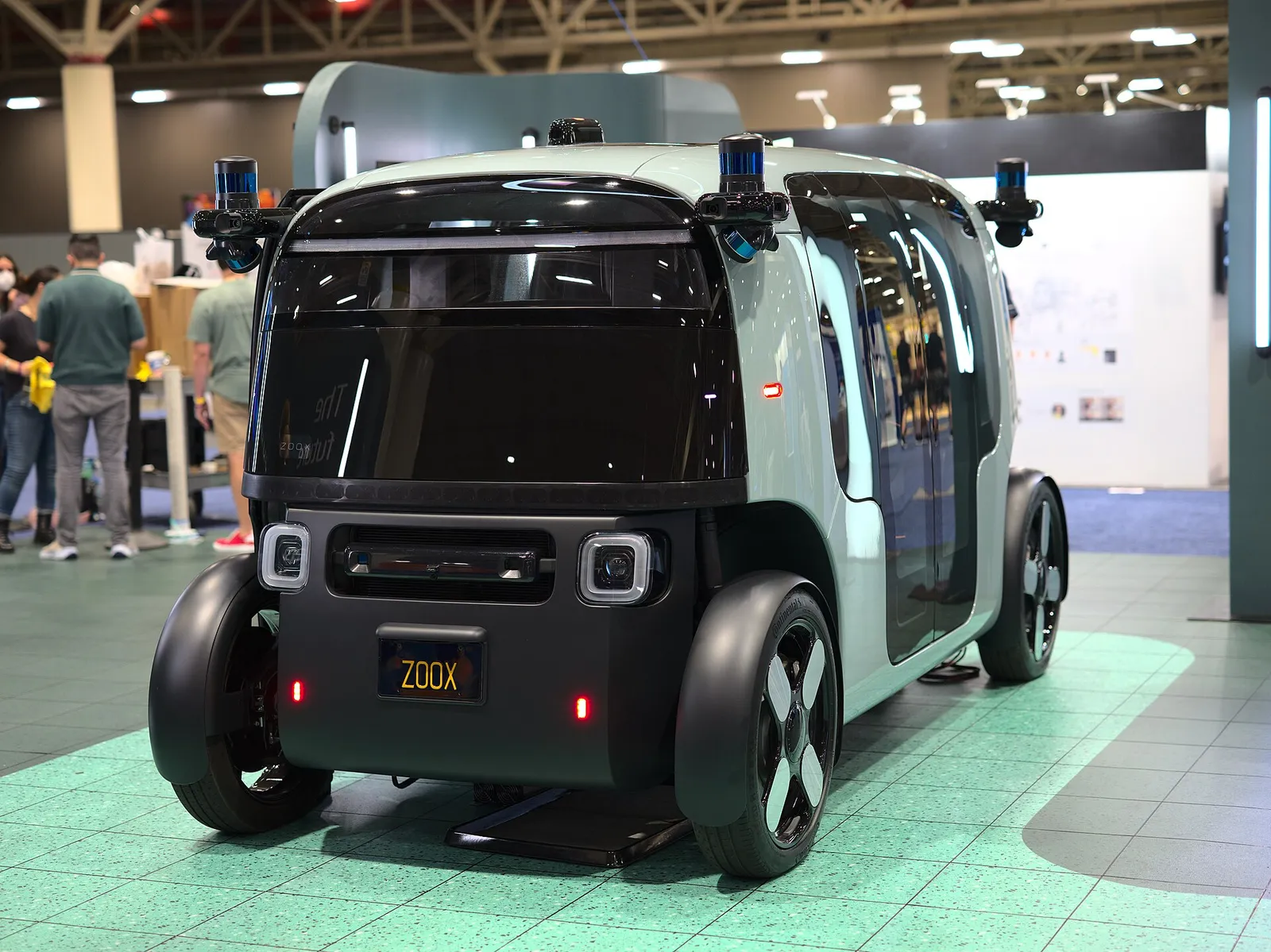
Zoox, the autonomous-vehicle subsidiary Amazon acquired in 2020, unveiled a redesigned robotaxi on June 24, tweaking its toaster-shaped vehicle based on rider feedback ahead of a planned commercial launch.
A "robotaxi" is a self-driving vehicle that picks up and drops off passengers without a human driver. Zoox's is "purpose-built," meaning it was designed from scratch as an autonomous vehicle rather than retrofitted from a conventional car. It has no steering wheel or pedals, drives bidirectionally with four-wheel steering, seats four passengers facing each other, and reaches up to 75 miles per hour. The company describes it as operating at Level 4 autonomy — an industry classification for a vehicle that can drive itself, within a defined service area and set of conditions, without human intervention.
A comfort-focused redesign
The update is largely about comfort and clarity rather than capability. Zoox added padding and ergonomic curves to seats and headrests, shifted to a lighter cabin palette, enlarged the cupholders, and made the touchscreen more visible; a new door speaker and microphone enable two-way audio with riders. On the exterior, Zoox enlarged and relocated the vehicle's reflectors, which help others distinguish the vehicle's front from its rear. The vehicle carries roughly 40 cameras, radars, lidars and infrared sensors.
The expansion plan
Zoox said it has served more than 500,000 riders since opening its Las Vegas service in September 2025, where rides have so far been free. In March, the company said it would expand in San Francisco and Las Vegas and begin testing in Austin, Texas, and Miami — its broadest U.S. push to date. A commercial launch with paid rides hinges on regulatory clearance, including an exemption from the National Highway Traffic Safety Administration for a vehicle without traditional driving controls.
Production runs out of a 220,000-square-foot factory in Hayward, California, which the company opened in 2025 and designed to eventually build up to 10,000 robotaxis a year.
The competitive picture
Amazon paid more than $1.2 billion for Zoox in 2020, though it never confirmed exact terms, and it does not break out Zoox's financial results in its disclosures. Zoox enters a market where Alphabet's Waymo is the clear front-runner, running paid driverless rides at scale in cities including Phoenix, San Francisco, Los Angeles and Austin, while Tesla presses its own robotaxi effort. Zoox's bet is that a vehicle engineered specifically for autonomy — rather than an adapted passenger car — will set it apart as the field crowds.